

El Segundo’s Mid-Century Homes and the Original Plumbing Risk
El Segundo has a distinct character among South Bay cities, with a compact residential core largely built during a single mid-century development period, sitting close to the coast but set apart from the beachfront cities to its south. This guide covers what makes hidden leaks a particular concern in El Segundo homes and what local factors are worth understanding.
A city built largely in one era
Much of El Segundo’s residential core was built in a relatively concentrated period from the 1920s through the 1950s, giving the city a more uniform housing stock than neighboring beach cities that have seen decades of scattered rebuilding. This means a large share of El Segundo homes share similar plumbing materials and installation approaches from roughly the same era, which is useful information: if your home’s plumbing has never been updated, it likely shares the same age-related risks as much of the surrounding neighborhood, rather than being an unusual outlier.
Original plumbing is common and worth checking
Because so much of El Segundo was built during the same mid-century period, a meaningful number of homes still have original galvanized steel or early copper plumbing that has never been fully replaced. Galvanized steel pipe, common in construction from this era, is particularly prone to internal corrosion and gradual narrowing of the pipe diameter as mineral deposits and rust build up over decades, which can eventually lead to reduced water pressure and, eventually, pinhole leaks as the pipe walls thin from the inside out. If your El Segundo home has not had a plumbing inspection in the past decade, and especially if it still has original pipe from its original construction, this is worth prioritizing.
Proximity to the coast without the same soil conditions
El Segundo sits close to the ocean, but much of its residential area is positioned slightly further back and at a higher elevation than the immediate beachfront neighborhoods in Manhattan Beach or Redondo Beach, which means somewhat less exposure to the loosest, most shifting sandy soil found right along the coastline. This does not eliminate soil-related stress on underground pipes and slab foundations, since the broader South Bay region shares similar geology, but it does mean El Segundo’s risk profile leans more heavily toward age-related pipe deterioration than the more soil-movement-driven risk seen in the immediate beachfront cities.
Industrial proximity and its indirect relevance
El Segundo is known for its proximity to industrial and aerospace facilities, and while this does not directly cause residential plumbing leaks, it does mean many El Segundo homes were built to serve a working population with different renovation patterns than a purely residential beach community. Some homes in the city have seen less cosmetic updating over the decades than comparable homes in more turnover-heavy markets, which can mean original systems, plumbing included, stay in place longer before anyone thinks to update them. This is not a negative reflection on the city, simply a pattern worth being aware of when assessing a specific property’s likely plumbing condition.
Slab leaks in El Segundo’s mid-century housing stock
Homes built during El Segundo’s main development period commonly used concrete slab foundations with copper or galvanized supply lines running underneath, the same combination that creates slab leak risk throughout the South Bay’s older housing stock. Given how much of the city was built in this style during a concentrated era, slab leaks are a genuinely common concern here, and warm spots on flooring, unexplained increases in the water bill, or the sound of water running with everything off are worth taking seriously rather than dismissing as a one-off occurrence.
Why age-based screening makes sense for this city specifically
Because El Segundo’s housing stock clusters so heavily around a specific era, a simple question, roughly when was the plumbing last replaced, is unusually predictive here compared to a city with more mixed construction history. A homeowner who knows their home was built in the 1940s and has never had a full repipe can reasonably assume they share plumbing-related risk factors with a large share of their neighbors, which makes proactive inspection an easier decision to justify than in a city where every property’s history is different.
What newer construction and remodels look like here
El Segundo has seen some newer construction and remodeling activity, though generally less dramatic rebuilding than Manhattan Beach’s teardown pattern. A remodeled El Segundo home has typically had at least partial plumbing updates, particularly in kitchens and bathrooms, but as with any partial renovation, it is worth confirming exactly which sections were updated rather than assuming the whole system was addressed. Our guide on choosing a leak detection company covers questions worth asking about a specific inspection scope.
Irrigation and yard leaks in a city of established landscaping
Many El Segundo properties have mature, established landscaping with irrigation systems that may themselves be original to the home or installed decades ago. An older sprinkler or irrigation system carries the same age-related wear as an older plumbing system, and a buried line that has been in the ground for thirty or forty years is more likely to have developed a crack or joint failure than a recently installed system. Checking your water meter periodically with irrigation off remains the most reliable way to catch this regardless of how long the system has been in place.
How to think about your home’s likely plumbing generation
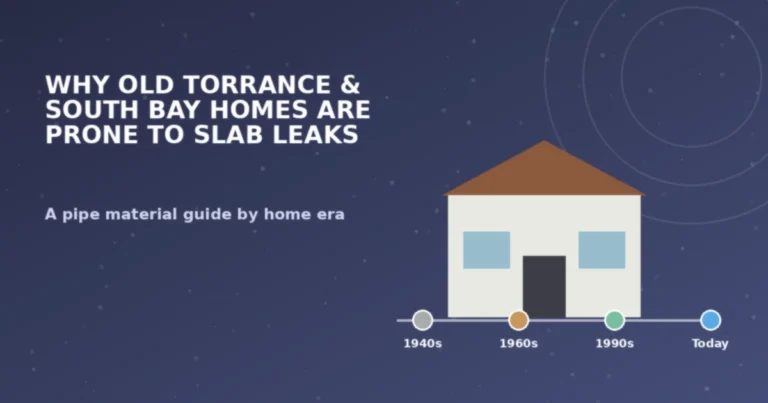
A useful way to think about risk in El Segundo is in terms of plumbing generations rather than exact years. Homes with truly original plumbing from the 1920s through 1950s construction boom represent the highest-risk group, since galvanized steel from this era is now many decades past the point where internal corrosion typically becomes a real concern. Homes that received a partial or full repipe at some point, often during a kitchen or bathroom remodel in the 1980s through 2000s, generally carry meaningfully lower risk, particularly if copper or modern PEX piping was used. The newest generation, homes repiped more recently or built new within the past two decades, carries the lowest age-related risk, though no home is entirely immune to a leak caused by installation issues or external damage. Placing your own home within this rough framework, even without exact documentation, can help calibrate how much attention your plumbing deserves.
What to ask if you are renting or considering a rental here
El Segundo has a meaningful rental market, including units in older buildings that may share the same original plumbing risk as owner-occupied homes from the same era. If you are renting in an older El Segundo property, it is reasonable to ask your landlord or property manager whether the plumbing has been updated and, if not, to report any early warning signs, such as reduced water pressure or unexplained dampness, promptly rather than waiting. Our guide on renters’ rights when a landlord will not address a leak covers what to do if a report does not get a timely response.
What happens once corroded galvanized pipe starts to fail
Galvanized pipe failure rarely happens all at once. It typically starts with gradually reduced water pressure as internal corrosion narrows the pipe’s usable diameter, followed eventually by small pinhole leaks that develop at the weakest points, often where the pipe has thinned the most or where fittings create additional stress. These pinhole leaks can appear anywhere along a run of pipe, including sections hidden inside walls or under flooring, which is why a homeowner who has noticed declining water pressure over several years should treat that as a meaningful warning sign rather than simply an inconvenience to work around. Addressing declining pressure early, before it progresses to an actual leak, often means the difference between a planned repipe project and an unplanned emergency repair.
Common questions about leaks in El Segundo homes
Is El Segundo more prone to leaks than other South Bay cities? Its risk comes primarily from the age of its housing stock rather than soil movement or salt air exposure, so homes with original plumbing carry meaningful risk regardless of proximity to the coast.
How do I know if my El Segundo home still has galvanized pipe? A plumber or leak detection specialist can typically identify pipe material during an inspection, and reduced water pressure over time can also be an indirect sign of internal corrosion in galvanized lines.
Should I repipe my home preventively if it still has original plumbing? This depends on the specific condition of your pipes, which a professional assessment can help determine, rather than assuming replacement is automatically necessary based on age alone.
The bottom line
El Segundo’s concentrated mid-century development period means a large share of homes share similar plumbing age and materials, making original galvanized or copper pipe a genuinely common concern rather than an isolated issue. Knowing roughly when your home’s plumbing was last updated, and getting a professional inspection if it has never been replaced, is a reasonable and fairly predictable step for most homeowners in this city. Because so many neighbors likely share the same plumbing generation, a conversation with a longtime neighbor about whether they have had leak issues can sometimes offer a useful, if informal, early signal about what to expect from your own aging system.
If you suspect a leak in your El Segundo home, our leak detection in El Segundo service page covers what a professional inspection involves and what it typically costs.
nn